Two people, from privileged backgrounds, went to Africa: one to Uganda, and one to The Gambia. Both were confronted with desperate situations of human poverty and human suffering.
One could not reconcile such suffering with a loving God who would allow it, who would not do something about it (is He not omnipotent?) and lost his faith – a well-known worship leader.* He left the church in search of answers.
The other** was intensely touched by the suffering he saw ‘Looking into their eyes, realizing they are the same as I am, created in the image of God, with the same needs and aspirations. The only difference is the place and circumstances we were born and neither of us had any say in that. Overwhelmed by knowing how blessed I am, I knew nothing in my life would be the same. Often crying in the plane on my way home. I need to share my blessings, I can not keep[ it to myself. I realized God was also blessing us to test our hearts – what are you doing with your blessings? I went home, gave it all up, all that I had, to serve God by serving the poor from this time onward.’
“I tell you the truth, whatever you did for the least of these, you did for Me” Matthew 25:40. Christ identifying with the suffering of this world, relieving His pain as we relieve their pain. One at a time. ‘It is better to light one candle than to curse the darkness’
‘LET MY HEART BE BROKEN BY THE THINGS THAT BREAK THE HEART OF GOD.’ – Bob Pierce
The words of Teresa of Avila, almost half a millennium ago:
‘Christ has no body now on earth but yours; no hands but yours; no feet but yours.
Yours are the eyes through which the compassion of Christ must look out on the world.’
From generation to generation He has heard their cries, shared their tears and asked His people again and again, ‘Who will go?’***
It’s not God who ignores the heart-cries of the poor, it’s us: you and me, His people around the world.
The simple key to fighting injustice and unlocking your highest destiny is the word ‘yes’ addressed to God. Perhaps He is waiting for you in a prayer room somewhere even now, inviting you to seek His Face to allow your heart to be broken with His deep concerns. Perhaps He is waiting to wreck your life for good; longing to give you the commission for which you were born. There is only one way to find out; See His face with a sincere heart. – From ‘Dirty Glory – Go where your prayers take you’ Pete Greig p 147 – 8
The Bible is God inspired. Science God created. Our task is to figure out this oneness.
Galileo Galilei (1564 – 1642). There are two sources of knowledge of knowing God. The Book of God’s Word and The Book of God’s Work. (Bible and Science)
It is equally wrong and damaging for the religious fundamentalist to ignore the facts of science as it is for the science fundamentalist to ignore Biblical and spiritual truths.
It is not that people cannot believe, but will not.
Romans 1:20 ‘For ever since the world was created, people have seen the earth and sky. Through everything God made, they can clearly see His invisible qualities—His eternal power and divine nature. So they have no excuse for not knowing God.’
What does it mean ‘Touched by God’? Is it real? Or just an emotion, a delusion? We will look at many encounters with God, in the Bible, in history, today. Life-changing encounters that often changed history in dramatic ways.
Hagar was the slave-wife of Abraham. She became pregnant when Abraham and Sarah became impatient with God, not believing Him really. With the strife between Hagar and Sarah, Hagar was sent away. God in the form of an angel came to her in the desert and told her to go back to Abraham and Sarah. He promised her that the son she was carrying will become a great nation and she should call him Ishmael. Hagar’s response was in Genesis 16:13 13 ‘She gave this name to the Lord who spoke to her: “You are the God who sees me,” for she said, “I have now seen the One who sees me.” – her encounter with the living God. This slave girl’s life was never the same and her name established in human history.
After 40 chapters of Job struggling with God, after he had lost everything as an ‘innocent’, good and righteous person, he declares in Job 42:5, after God spoke to him and confronted him, ‘“but now my eyes have seen You”’ and verse 10 ‘God restored him.’ He has seen God, who God is, encountered the living God, understood more of who God is, and his life was changed in a dramatic way.
There are many reasons why people believe in God, least of which should be emotional justifications or ‘blind faith’. Are there good rational reasons to believe in God? The two reasons why I believe in God is first, my personal experiences of His love and presence daily and the profound changes that took place in my life that far exceeds mere emotional experiences and secondly, confirming my experiences, the good evidence for His existence. The radical change that took place in my heart was not from a rational decision but in response to an overwhelming Love that became rational. www.torquetalk.nl
Jacob with a name meaning ‘deceiver’ had to flee for his life after he deceived his brother Esau out of his firstborn right. Years later God told him to go back to the land of his birth and also face his brother. The night before he was to meet his brother, he had a dream: God appeared to him in the form of an angel and the whole night he wrestled with God. In Genesis 32: 30 Jacob named the place Peniel (which means “face of God”), for he said, “I have seen God face to face” and God changed his name changed from Jacob – the deceiver to Israel – people who struggle with God, being engaged with God. It is often in our struggles that we meet God and throughout our lives we are engaged with the living One, struggling. After this encounter, nothing was the same for Jacob and he became the father of the nation of Israel into which the Messiah was born.
Paul. A devote Pharisee and committed to God and the Jewish religion was determined to destroy the new ‘sect’ of Christ-followers but suddenly overwhelmed by God on his way to Damascus, on his way to arrest and put Christ-followers in jail, destroy the newly formed church.
A bright light surrounded him and his party traveling with him. Acts 9:4 ‘He fell to the ground and heard a voice saying to him, “Saul! Saul! Why are you persecuting Me?” 5 “Who are You, lord?” Saul asked. A rhetorical question really. Paul knew who he was persecuting.
Paul had the most radical change in his life when encountering the living Christ. He later declared in 1 Corinthians 9:1 ‘Have I not seen Jesus our Lord?’ Instead of persecuting the church, he became the most famous spokesman for Christ and wrote 13 letters/books of the New Testament that profoundly influenced human history and still do.
Blaise Pascal was one of the greatest mathematicians, physicists and engineers of all time. While still in his teens he invented the first mechanical calculator – a precursor to modern computers. He created at least two new fields of mathematical research. His Law of Probability is still used by economists today. His name has been lent to a unit of pressure and a programming language. He developed the first bus route for Paris. But the defining moment of Pascal’s life came on in November 1654 between 10.30 and 12.30 at night. Often described as his ‘Night of Fire’, we only know about it because of some Words written secretly on a slip of paper and sewn into his jacket, discovered at last by a curious servant after the great man death:
Fire.
God of Abraham,
God of Isaac, God of Jacob,
not of philosophers and scholars.
Certainty certainty,
heartfelt joy, peace.
God of Jesus Christ.
That mysterious encounter with God changed Pascal’s life. Thereafter he turned his intellect towards theology and philosophy. His book Pensées is widely considered a masterpiece of prose.
Martin Luther King’s encounter
One night after a particularly threatening phone call, Martin Luther King Jr got out of bed, made coffee, and bowed at his kitchen table. He was worried about his family and the burden of his responsibilities weighed heavily on his shoulders. ‘Lord/ he prayed aloud, ‘I am taking a stand for what I believe is right. The people are looking to me for leadership, and if I stand before them without strength and courage, they will falter. I am at the end of my powers. I have nothing left. I have come to the point where I can’t face it alone.’ Later he told his wife, ‘At that moment, I experienced the presence of the Divine as I had never experienced Him before.’ Martin Luther King Jr was imbued with a new sense of confidence through that encounter. In fact, his wife would later recall that it was a turning point, after which he became willing and able to face anything.
Have you had an encounter with the Living Christ?
‘You will seek me and find me, when you seek me with all your heart.’ Jeremiah 29:13
Not everyone’s encounter with the living Christ is as dramatic as Paul and others. It is however very personal and very unique and can happen in a moment but in many also over a period of weeks, months, years. Like David growing closer and closer to God over the years of fleeing from Saul, and writing most of the Psalms.
None of the people I mentioned, including myself, did not have a relationship with God prior to their encounter with God. Andrew Murray, Scottish/South African missionary and writer of at least 30 Christian books, talk about a ‘second blessing’. A rebirth. John 3: 3 Jesus replied, “I tell you the truth, unless you are born again, you cannot see the Kingdom of God.” 6 Humans can reproduce only human life, but the Holy Spirit gives birth to spiritual life. The spiritual life that Paul talks about in Romans 8, the whole chapter and specifically v 15 …you received God’s Spirit when He adopted you as His own children. Now we call him, “Abba, Father.” (Abba = term expressing warm affection and family confidence.) 16 For His Spirit joins with our spirit to affirm that we are God’s children. (Tim Keller stated that the closest we come to the true meaning of Abba is ‘daddy’ and that is what we can call our Father in heaven)
To get into such a close intimate relationship with God, we can exclaim with Paul: 21 ‘For me, living means living for Christ, and dying is even better. 23 … I long to go and be with Christ, …’
How do we get there, experience such life-changing encounters?
Floyd McClung. Writer of ‘The Father Heart of God’
How do I follow God?
‘Ask God to show you His glory (who He is), so much that you fall
in love with Him.
After this you will do anything for Him’
‘You will seek me and find me, when you seek me with all your heart.’ Jeremiah 29:13
Tim Keller
‘Jesus the Christ asks for far more than you ever thought but offers far more than you ever dreamed.’
To be touched by God, to have an encounter with Him, is profoundly deeper than a mere emotional experience, it is life-changing and can be confirmed by the rational evidence for the truth and reliability of the Gospels and the resurrection of Christ.
Head knowledge is informative, really important, but heart knowledge transforms our lives. ‘And [I pray] that the eyes of your heart [the very center and core of your being] may be enlightened [flooded with light by the Holy Spirit]’ Ephesians 1:18 AMP
Have you had an encounter with the Living God, Christ, our LORD and God? If not, I urge you, seek Him and you’ll experience the deepest reason for being alive.
‘If I understand you correctly, you object to the moral evil in this world. That the extreme moral evil committed by humans, like what happened during the Holocaust, would not have been allowed by a loving God if He is all powerful. You find that logically inconsistent? You might be more comfortable with the existence of evil in the absence of such a God? Suffering and evil just a brute fact of life. A pitiless indifferent universe and evil caused by individual decisions or natural disasters. But the existence of a loving God that can prevent it but doesn’t? No. Or if He does exist, that you would rather have nothing to do with Him?’
I can respond with some common, though inadequate poor theological explanations, to this very valid objection but that might make you even more convinced that either He does not exist or if He does, that you would rather not know Him. But here they are: 1. ‘He does whatever pleases Him.’ Psalm 115:3 God can do whatever He wants. No, God will not do anything contrary to His moral character. He is committed to perfect goodness. 2. There has to be evil for good to be possible. No, light does not depend on darkness. Light is an independent entity, and not dependent on darkness. Darkness is not even an entity, it is just the absence of light. Goodness is an entity, it is an absolute and can exist without evil. Evil is relational, cannot exist without good. 3. All suffering is punishment – No, this is not a scriptural statement. John 9:2 ‘His disciples asked Him, “Teacher, who sinned, this man or his parents, that he would be born blind?” Jesus answered, “Neither this man nor his parents sinned, but it was so that the works of God might be displayed and illustrated in him. …’
Putting these implausible reasons for suffering and the existence for God aside, let us look at more intellectual reasoning why the co-existence of God and suffering is not mutually exclusive as might be suggested in your objection.
I. The Logical Argument.
There is unspeakable suffering in the world. Yet people claim the existence of an all-loving (omnibenevolent) and all-powerful (omnipotent) God. Even if He does exist why would you want to worship Him, you might ask? Let us consider this objection.
If God is willing to prevent evil but not able, then He is not all-powerful. If He is able to prevent evil but not willing, then He is not good. But if He is both willing and able, how can evil exist? If He is not able and not willing, why call Him God?. And if one still believe in such a God, it is irrational.
There are two statements in the above: 1) An all-powerful, all-loving God exists and 2) suffering exists. Are these two statements logically inconsistent? No, it is not the same as; This is a circle – it has a square shape – these are two logically inconsistent statements. There are no logical contradictions in the first two statements.
Are therehidden assumptions? Yes.
1. If God is all-powerful; He can create any world He wants.
2. If God is all-loving; He prefers a world without suffering.
Therefore, an all-loving all-powerful God can create any world He wants and He wants it without suffering. Since suffering exists, you might conclude, an all-powerful, all-loving God does not exist.
But are the assumptions true?
Can God create any world He wants?
What if God wants free will? It is logically impossible for God to force someone to choose to do good. It is not that God lacks the power but the task is illogical. You cannot have a world with free will and everybody chooses only to be morally good humans. (Alvin Plantinga – free will defense, Freedom and Evil)
Assumption one can, therefore, is not be true.
2. If God is all-loving, He prefers a world without suffering.
Is it true that God necessarily prefers a world without suffering? How can we know this? We permit suffering in our lives for the greater good e.g. surgery.
IfGod can allow suffering to bring about greater good, then assumption 2 is also not necessarily true.
For For the logical argument to succeed you have to show that it is logically impossible that free will exists and that it is logically impossible that God has good reasons for permitting suffering.
Therefore, it is possible and very reasonable to believe that God an all-loving, all-powerful God and suffering can exist simultaneously.
If it is logically possible that God and suffering both exist, is it likely with so much suffering, you might ask? It seems improbable that God could have sufficient reasons for permitting it:
II. The Evidential Argument.
The magnitude of suffering provides empirical evidence that God’s existence is improbable. Not impossible but highly unlikely. It appeals to the preponderance of the evidence of evil weighed against the probability of the existence of a good God. Is this a good argument? An argument that goes from ‘no apparent’ reason to ‘no morally sufficient’ reason. In defense against this argument, consider the following:
We cannot say that God probably lacks reason for allowing suffering in the world. The problem is that we are limited in time, space, intelligence and insight. God knows all history from beginning to end. To achieve His purpose God may well have to allow a great deal of suffering. It is in our limited scope of understanding it might seem pointless.
2. Relative to the full scope of evidence, God’s existence might well be probable. Probabilities are always relative to background information. New information my change our understanding of the problem. If we only consider the suffering in the world, then God’s existence might well seem improbable. But, if we are willing to consider all the different arguments for the existence of God e.g.; the cosmological argument, finetuning argument (teleological-), intentionality, evidence for the resurrection of Christ, we might come to a different conclusion. The preponderance of evidence favors the existence of an all-loving, all-knowing God, even in the reality of the existence of evil, and this, I would argue, is beyond reasonable doubt.
3. Christianity entails doctrines that increase the probability of the coexistence of God and suffering
i) The chief purpose of life is not happiness but to know God – this brings true lasting fulfillment. Suffering can bring a deeper knowledge of God. Through suffering God can draw people freely to Himself – the free will defense.
ii) Mankind is in a state of rebellion against God and His purpose. The Christian is not surprised at moral evil but expect it.
iii) God’s purpose is not restricted to this life but extends into eternal life. Paul’s hardship and afflictions: ‘We do not lose heart’ 2 Corinthians 4: 16-18.
iv) The knowledge of God is an incomparable good. Knowing God is the ultimate fulfilment of human existence. So, the Christian, no matter how much he suffers, can still say ‘God is good to me’
Therefore, if Christianity is true it is not improbable that suffering and evil exists.
The evidential argument of evil and God is not reasonable.
And as a purely intellectual problem, the problem of evil but does not disprove God’s existence?
The emotional problem of suffering and evil remains and is very powerful in the face of intense pain. But to remove God from the reality of pain and suffering and deny His existence, does not solve the problem. Evil and suffering will still be real but it will surely be difficult, if not impossible, to find meaning in it.
Our response to evil and suffering will determine its meaning in our lives; it can draw us to God or drive us away from God.
One might still feel ‘Why do I want to worship God that allows so much suffering?’ You are not alone. He knows you and your circumstances. He promises to be with you. He will give you the strength. Jesus Christ also suffered, although innocent, to reconcile us with God and give us internal life without pain and suffering. The ultimate purpose in life is to know God, to enjoy God now and forever and, even more intimately if that is His will in our lives, through our suffering.
If you look for Me wholeheartedly, you will find Me. Jeremiah 29:13
There are many reasons why people believe in God, least of which should be emotional justifications or ‘blind faith’. Are there good rational reasons to believe in God? The two reasons why I believe in God is firstly, my personal experiences of His love and presence and the profound changes that took place in my life that far exceeds mere emotional experiences and secondly, confirming my experiences, the good evidence for His existence. The radical change that took place in my heart was not from a rational decision but in response to an overwhelming Love that became rational. www.torquetalk.nl
Not regarding emotional convictions and beliefs, or ‘blind faith’, or any individualistic subjective experiences of the love of God and of His presence, what are rational arguments to believe in God?
Some of the arguments reasoning for the existence of God are:
The evidence from what exists, from what we observe (Romans 1:20*); the impossibility of an eternal universe and the evidence for a finite beginning. Secondly, the design argument (the laws, the order and fine-tuning we observe in nature pointing to a mind behind it), and the information represented in DNA (again pointing to a mind – if you read the letters/information in a book you know there is a mind behind it). 2. The absurdity of life without God if the universe and humans are just the product of time + matter + chance (atheistic/materialistic view) and everything, man and the cosmos, will end up in death, it eliminates any possibility of any ultimate meaning in existence. 3. No objective morality possible in the absence of a moral Lawgiver. 4. The reliability of the Gospel manuscripts. 5. Evidence for the resurrection.
Discussion of Two of the Arguments why the Believe in God is Rational
I. Arguments for the Existence of God; The Beginning of the Universe and Design.
We exist in a universe that exists. Has it always been there, always existed, and we happen to find ourselves in this eternal universe? Atheist Bertrand Russell; ‘The universe is just there and that’s all’
But there is no evidence for an eternal universe, rather there is evidence for the universe with a finite beginning: 1.The philosophical argument: If the universe had no beginning, reaching the present moment would require crossing an actual infinite number of moments, crossing actual infinity, and the present moment would have never arrived. The present moment has arrived. Therefore, the universe has a beginning. 2.The scientific argument; the Second Law of Thermodynamics; a process taking place in a closed system always tend toward a state of equilibrium – useful energy constantly decreases over time. Therefore, the universe is slowly running out of its useful energy. If the universe had been here forever, it would have run out of usable energy by now. Thus, the Second Law of Thermodynamics points to a universe that has had a finite beginning. This was confirmed by Albert Einstein’s general theory of relativity (1915). Alexander Friedman and George Lamaitre, working with this theory, predicted the expanding universe. This was confirmed by Edwin Hubble, in 1927, by measuring the Red Shift in the light from distant galaxies – this empirical evidence confirmed that the universe was expanding and sprang into being from a single point in the finite past.
Therefore, the universe has a beginning. If the universe had a beginning, was it caused? And if caused, was it necessarily caused by an uncaused cause?
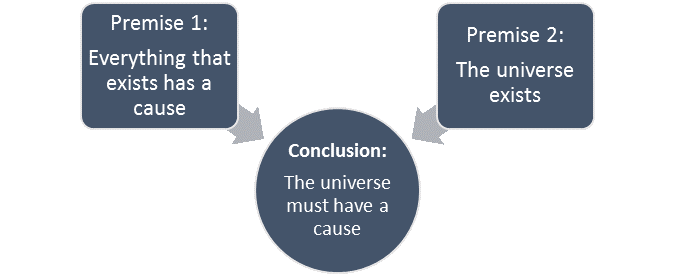
Consider the Kalam Cosmological Argument; Premise 1, Whatever begins to exist has a cause. Premise 2, The universe began to exist 3. Conclusion: The universe has a cause. But is premise 1 true? There is no example in the universe of anything coming into existence out of nothing. Everyday experience and scientific evidence confirm premise 1. We have argued that Premise 2 is true; the universe had a beginning, began to exist.
With both premises true, the conclusion, the universe has a cause, is true.
The universe can’t cause itself. Its cause must be beyond the space-time universe with its innate matter and energy properties. The cause must be timeless, space less, immaterial, uncaused, and powerful, acting from a free will (volition). The Judeo-Christian, (and other mono-theistic religions), concept of God.
We observe laws in the universe; laws of motion, of heat, of chemistry. Add to this the constants of nature, extremely finely balanced, e.g. gravity, weight of an electron; the minutest variations in these constants, of which there are about 25, and life would not have been possible. These all point to a mind behind the laws, behind the order and the finetuning. Science cannot explain the existence of the laws, or why there is order.
It is reasonable to assume a mind, a Designer, behind the beginning of the universe, the laws and order we observe, and the finetuning.
It is therefore reasonable to believe in the existence of God.
II. Objective Morality as a Rational Reason to Believe in God.
If there is moral objectivity, and deep inside we all know there is, then it is best explained by a moral lawgiver, an objective moral standard outside of us. We know there are some things that are absolutely morally wrong, e.g. killing people for fun, stealing, and some things that are morally right, e.g. caring for the sick, love people;
1. Moral truths have imperative truths behind them. They have the force of command ‘Do not steal’. This imperative force is best explained if there is a Commander behind them.
2. Moral law produces shame and guilt when we violate it. More than guilt or shame in the face of society. It is difficult to explain this guilt or shame in the face a moral abstract that doesn’t have a person behind it.
3. Why is morality present in the universe?
4. Why do humans have equal value and rights? Human beings are not equal in almost all aspects, e.g. intelligence, beauty, strength. Humans must have something in common that gives them equal value and whatever that is must be weighty. We are all created in the image of God and it is impossible to justify equal rights without God.
Without God there cannot be objective morality. There can only be an expression of individual taste; subjectivism, relativism, which makes it impossible to judge good and bad on a cultural, societal, or personal level as it will differ from society to society, culture to culture and person to person.
Can one be good without believing in God? Absolutely, but can you be good without God? One would argue that this is not possible.
If God does not exist, objective moral values do not exist; without an objective reference point we cannot say that something is really good or bad, right or wrong. God’s nature is the standard against which all truths, right or wrong, is measured. It provides an objective moral reference point, the standard against which all decisions and actions are measured. Without God there is no such reference point and we are left with individuals point a viewpoint. One individual’s view not more valid than anybody else’s; subjective morality only. Without God there cannot be evil or good. God expressed His moral nature as commands, in moral duties; love, generosity, sacrifice, equality, and the opposite greed, abuse, discrimination. God is the standard of moral values; the more one’s actions and decisions is like God’s nature the better it is. There are no moral obligations or duties without God. The atheist see man merely as a higher animal, but animals has no moral obligations; no right or wrong.
Our moral experience convinces us that moral values are objectively real every time we say ‘that’s not fair’, ‘that’s wrong’. It affirms our believe in objective moral values. Think of racial injustice, child abuse; everybody knows it is wrong and not personal preference.
The moral argument for the existence of God is; if God does not exist, subjective moral values and duties do not exist. Objective moral values and duties do exist; therefore, God exists.
Without God as the foundation of life it is hard to find meaningful existence. He is the foundation of meaning. History tells us that without God worldviews and ideologies fail even as meaning is being sought in current narratives and courses, however worthy they might be. They can never satisfy the inborn soul search of man: what is the purpose of man?
Here is why.
Atheist Richard Dawkins: there is no meaning.
The universe we observe, with its blind physical forces and genetic replication (selfish genes), has precisely the properties we should expect if there is, at the bottom, no design, no purpose, no evil, no good, nothing but blind, pitiless indifference. DNA neither knows nor cares. DNA just is and we dance to its music. – the words by Richard Dawkins an English ethologist, evolutionary biologist, and author. An atheist and writer of, amongst many other books, ‘The God Delusion’
As a materialist and atheist one is forced to come to no other conclusion than Dawkins did. To try and create meaning in life with this worldview, one has to be dishonest and delude yourself, as ultimately nothing has meaning.
So how do you live honestly without God? Some suggestions by famous thinkers and atheists: Friedrich Nietzsche – ‘Face the absurdity of life and live valiantly’ or Bertrand Russel – ‘Come to terms with life by realizing the world is a terrible place’, and Albert Camus – ‘Honestly recognize life’s absurdity and then live in love’ (Frank Turek, Christian Apologist, would say ‘stealing from God’ to make sense of life’. God is the only source of love).
With a worldview that there is no God you cannot live honestly – believing there is no ultimate meaning in life, and be happy, with the sword of ‘no ultimate meaning’ hanging over you head. You have to delude yourself to believe you can live honestly, happy and meaningful when there is no ultimate meaning.
People will keep on searching for meaning, it is engraved onto the soul.
Douglas Murray: people try to find meaning elsewhere, as religion has collapsed in many lives, and even more so in the Western World.
I have a lot of respect for Douglas Murray, a British author and political commentator, founder of the Centre for Social Cohesion and associate editor of the British political and cultural magazine The Spectator. I think his insight into current issues, social and political, are astounding. Quoting him is not so much about what he said but more about what came out of the discussion about modern worldviews and the meaning of life.
Douglas Murray, ‘Something incredibly deep has happened in our societies. Collapse of the grand narratives. For the first time in human history man has no explanation for what we are doing here and no story to tell about what we should do other than through other narratives though weak, eg accumulate as much money as possible and enjoy life – fairly shallow’ Reminds me of Ecclesiastes 1: 1-3 “Meaningless! Meaningless!”
‘This is the consequence of collapse of religion, which is very much irreversible now, the collapse of all major political ideologies other than capitalist economy. And recently a lot of confidence was lost in capitalism. We have run out of things to believe in and pretend to just find your own meaning in the world. So people get caught up in new ideologies. Justice movements is a way to give life meaning. Equal rights for women, LGTB, race rights are good but are the products of liberal rights but except of being the product of it we have flipped it around and trying to sit on the products that can’t support itself. Each are more unstable than we are willing to admit. E.g. being gay, still a lot unknown, we know so little about trans people, women’s rights, and racial issues are so deeply complicated, these problems are very complicated, and we don’t know much about it.‘
Good causes are good, but like most things in life, can give meaning and satisfy the soul for only limited periods of time.
William Lane Craig: life without God is absurd.
‘Man is the only creature who asks ‘why?’. Without God the answers are dark and terrible; we are only the by-product of nature, the result of matter + time + chance. There is no reason for our existence, and we will end up in death.’ William Lane Craig, Christian Apologist.
Very little, more likely none at all, of what an individual did who lived a hundred years ago,, or any time in history, are remembered today and none of their acts of right or wrong, good or bad, has any significance today – unless the individual was very famous and or did very remarkable things in his or her lifetime. Even these famous are remembered for the significant thing they did but none of their day to day acts; moral decisions, acts towards others, love and kindness shown or withheld, possible cruelty, have any significance today. All forgotten into the endless space of time.
Each individual will die, the whole human race and the universe will cease to exist. And end up as a cold, dead, lifeless, lightless universe swallowed up by black holes. If the human race then end up in nothing, with no conscious mind knowing or remembering its existence, then the human race is ultimately nothing, has ultimately no meaning. What you do today is only important today to satisfy your selfish genes and propagate them to an ultimate meaningless end.
The modern western society, to a large extent, has lost its moral compass, has lost its meaning in life. It tries to find meaning in social justice movements, which in itself is good, but can never satisfy the yearning of the soul. (LGBT, race, woman’s rights, green environment, humanism serving the less fortunate, etc)
Timeless Truths and Meaning: ‘I am the way and the truth and the life.’ John 14:6
The struggle to find meaning is not new, it has forever been in the hearts of men.
Around 950 B.C.
“Meaningless! Meaningless!” says the Teacher.” Utterly meaningless! Everything is meaningless.” What do people gain from all their labors at which they toil under the sun?“ Ecclesiastes 1: 2-3
And around 400 BC St Augustine wrote that there is a God shaped void in each human that only God can fill.
‘Yet when I surveyed all that my hands had done and what I had toiled to achieve, everything was meaningless, a chasing after the wind; nothing was gained under the sun.’ Ecclesiastes 2:11 ‘For the fate of the sons of men and the fate of animals is the same. As one dies, so dies the other.’ Ecclesiastes 3:19
‘Then I saw all that God has done. No one can comprehend (everything) what goes on under the sun. Despite all their efforts to search it out, no one can discover its meaning. Even if the wise claim they know, they can’t really comprehend it.’ Ecclesiastes 8:17
The conclusion of the writer on the ultimate meaning in life: : ‘Fear God (awe-filled reverence, knowing that He is almighty) and keep His commandments, for this is the duty of all mankind.’ Ecclesiastes 12:13
Jesus replied: “‘Love the Lord your God with all your heart and with all your soul and with all your mind.’ This is the first and greatest commandment. And the second is like it: ‘Love your neighbor as yourself.’ Matthew 22: 37-9
The fear of the Lord is the beginning of wisdom, and knowledge of the Holy One is understanding. Proverbs 9:10
Why should you regard wisdom of thousands of years ago? Because 2 + 2 = 4, this has been true ‘for millions of years’ – has always been true and will always be true. Truth does not depend on time. And God is omnipresent – always present in all space and time, all the time the same time. And Christ is current, present and a reality in the lives of million of Christians today who has a living relationship with Him.
Furthermore, Christianity can be investigated for its truth. It is the only religion not based on ‘blind faith’ (Buddhism, Baháʼí Faith; endless search for the ever evading ‘enlightment’) nor fear (Islam; fear of hell, and the consequences suffered through family and friends if the faith is renounced) but Christianity is based on historical verifiable facts and a personal encounter with God. www.torquetalk.nl
If God made us to His image, Genesis 1:271, then we have a free will to love (not a dance to our DNA to propagate our genes re the atheist Dawkins’s worldview), free to appreciate the beauty in the creation, the beauty in music and art and find endless delight in recognizing and loving the Creator2. We can know and experience that He has a plan for our lives3 and eternal life4; an existence in the presence of the loving God5 who is love 6and nothing but good7.
(1So God created mankind in his own image. Genesis 1:27 2Great are the works of the Lord; they are pondered by all who delight in them. Psalm 111:2. 3 For I know the plans I have for you,” declares the Lord, “plans to prosper you and not to harm you, plans to give you hope and a future Jeremiah 29:11. 4 For God so loved the world that He gave His one and only Son, that whoever believes in Him shall not perish but have eternal life. John 3:16. 5, 2015 And if I go and prepare a place for you, … and take you to be with Me that you also may be where I am. John 14:3 6 And so we know and rely on the love God has for us. God is love. Whoever lives in love lives in God, and God in them. 1 John 4:16. 7 Taste and see that the LORD is good; blessed is the one who takes refuge in Him. Psalm 34:8)
Christianity is the only religion that can be factually investigated. If you doubt, think about the most important question ever asked in history and in the words of C.S Lewis, atheist turned Christian, there are only there possible answers to this question; Lunatic, Liar or LORD.
“But what about you?” He (Jesus Christ) asked. “Who do you say I am?”
Matthew 16:15
Investigate the facts; the evidence for the resurrection, the reliability of the New Testament of the Bible, investigate the prophecies, everything you think Christians just accept as true. No, there are good, reliable evidence. For each.
If God is omnipresent in space – present everywhere, is He also omnipresent in time – present in all times at the same time?
Do we have evidence for it, and what are the implications if God is also omnipresent in time?
The Judeo-Christian understanding of God:
In the scriptures He is portrayed as all-powerful (omnipotent), present everywhere (omnipresent), all-knowing (omniscient), all loving and good (omnibenevolent), self-existent, eternal, spirit (i.e. immaterial), perfect in beauty and, personal.
I. What does it mean when we say that God is omnipresent?
And specifically, omnipresent in time?
The definition of omnipresent depends on the source one consults.
1. Present everywhere at the same time – space.
2. Present in all places at all times – space and time.
In general terms we mostly understand omnipresence as present everywhere in space. Though many Christians instinctively believe that God knows our future so well, that He knows our every moment, from before birth, now and till the day of our death. (My mother loves to say ‘Don’t worry about your future, God is already there’). Also omnipresent in time.
If God is God and He created time (see below), He cannot be kept captive by time. Just as He is omnipresent in this universe, He is omnipresent in time; present in yesterday, today & tomorrow, at all times at the same time. Present ‘now’ in every second since creation of time till the end of time. Not bound by space neither by time – present in all space and all time.
Being omnipresent in space, ‘present everywhere at the same time’, is hard enough to try and get some understanding of. But God is profoundly more. He can neither be confined to space nor can He be controlled or limited by time, lest He is not God and did not create time and space. He is, therefore, also omnipresent in time – ‘present everywhere in space and time’.
II. But do we have good reasons to believe that God is indeed omnipresent in time?
1. Science based reason
God as the first and uncaused cause of the universe:
The Kalam Cosmological Argument
God is the most reasonable explanation for the first (uncaused) cause of the universe. In fact, there is no other reasonable explanation, neither in science nor in philosophy.
As the first and uncaused cause of the universe, God necessarily and logically must have been outside of the universe to have caused it. Put differently, to create time, matter, space and energy, God cannot consist of, or be subject to time, matter, space and energy. He could not have had any of these four named attributes as part of Himself (otherwise He would have had to create something of Himself – and being imperfect).
Genesis 1:1 (NLT) ‘In the beginning God created the heavens and the earth.’
It was only in the last century that scientists discovered and now accept it as fact that the universe had a beginning and is not eternal as was thought and accepted for millennia by scientists, especially non-believing scientists (hoping the Bible was wrong). This first, and very significant verse of the Bible, is supported by scientific discovery.
God, separate from space, time, and matter, must rationally be all-powerful (omnipotent), enormously wise and infinitely intelligent (omniscient), not bound by time and space (omnipresent and eternal), immaterial (spirit), and personal (to have willed) to have created the universe, and us. Exactly our understanding who the Biblical God is and a logical explanation for the existence of the universe.
We can conclude that if God created time, He must be outside of time, (as He is outside of space) and therefore not bound by it and must be omnipresent in time, present in all times all the time.
2. Theological basis for God’s omnipresence in time
Continual Existence;
a. Genesis 1:1 (NLT) ‘In the beginning God created the heavens and the earth.’
From John 1: 1-4 (AMP) ‘In the beginning, before all time, was the Word, Christ, and the Word (Christ) was with God, and the Word was God Himself. He (Christ) was, continually existing, in the beginning, co-eternally, with God. All things were made and came into existence through Him; and without Him not even one thing was made that has come into being….’ Always existing, always present (continually and eternally).
Hebrews 13:8 (NLT) ‘Jesus Christ is the same yesterday, today, and forever.’ Christ is the same yesterday, today and tomorrow because He exists in all time and space, He is unchangeable. Not Christ ‘was’ the same yesterday and ‘will be’ in future but ‘is’.
b. God answered Moses, on the question ‘Who should I say sent me’, ‘I am’, God said. Exodus 3:14 ‘God replied to Moses, “I am who I am. Say this to the people of Israel: I am has sent me (Moses) to you.” God declared Himself as the ever-existing ‘I am’ … the one present everywhere in space and time with no history or future but omnipresent in time, ever existing.
So did Jesus Christ, Son in the triune God, declare in John 8:58 “I tell you the truth, before Abraham was even born, I am!” Present in all times.
c. Psalm 90:2 ‘Before You created the whole world and the mountains were made, from the beginning to the end You are God.’ Not ‘was’ or ‘will be’, but ‘are’ God – present tense, eternal.
III. If He is omnipresent (in time), what does this mean for how we view Him, and how we understand His view of us?
a. God’s knowledge of us
Being separate (outside) of space, He is omnipresent in space, – present everywhere in the universe and in the hearts of men. Being separate (outside) of time, He is omnipresent in time, – present from the moment the universe came into existence to when everything will come to an end (scientific evidence points to a cosmos that will eventually burn out as predicted in the book of Revelation). God is present ‘now’ in every second from the beginning to the end. The eternal God will continue to exist when time comes to an end (with people who trust and believe Him) just as He existed before He created time. 1 Corinthians 2:7 ‘No, we declare God’s wisdom, a mystery that has been hidden and that God destined for our glory before time began.’ Confirming that time had a beginning.
Hebrews 13:8 (NLT) ‘Jesus Christ is the same yesterday, today, and forever.’ Christ is the same yesterday, today and tomorrow because He exists in all time and space, therefore unchangeable. He is what He is, the I am, unchangeable, present everywhere and in time, present in our past, in our present and in our future, and therefore all knowing. He is ‘now’, this moment, present in all our future, present and past decisions – all-knowing (omniscient).
b. It is impossible for God’s to lie or not to fulfil His promises
Numbers 23:19 “God is not a man, that He should lie, …”
Hebrews 6:18 ‘… it is impossible for God to lie’
Samuel 15:29 ‘Also the Glory of Israel will not lie or change His mind; for He is not a man that He should change His mind.‘
Because He is ever-present in all times at the same time, it makes it impossible for Him to go ‘back on His word (promises) or decisions’ like humans can who move on in time.
c. Free will
God is love. Love per definition, in essence, has to be free. Man is created in the image of God – Genesis 1:27. We can love and have a free will to choose (there is no such thing as forced love).
God being omnipresent in time and present when we make decisions, and also present in our future decisions as we will make them, He knows it in the ‘now’, our now, but He is present at the time of our future decisions because He is not bound by time. Because He is in our future, He knows what we will decide or choose, therefore not predetermined but His concurrent omniscience and omnipresence.
(The materialistic atheistic worldview forces one to discard the possibility of free will – humans are the result of unguided processes and our thoughts and actions the result of and based on our genes, chemical processes and environment with nothing higher/apart from the brain. Atheist Sam Harris ‘Free will is an illusion so convincing that people simply refuse to believe that we don’t have it.’ ‘Yes, free will is an illusion,’ Richard Dawkins )
d. The Reliability of Prophecy
Isaiah 9:6 ‘For a Child is born to us, a Son is given to us. The government will rest on His shoulders. And He will be called: Wonderful Counsellor, Mighty God, Everlasting Father, Prince of Peace.’ God being present in all times, does not predict the future as in this passage written approximately 700 years before the birth of Christ, but Him being present in the future, also when this happened, revealed it to Isaiah 700 years before the birth. He was present when He told Isaiah and at the same time present when the Child was born because of His omnipresence. This is equally true for all the prophesies in the Bible, Old and New Testament, and therefore no surprise that not one of them turned out not to be true. His concurrent omniscience and omnipresence.
e. God’s “current” presence on the cross (Enormous grace and humility)
And the frightening realization is that God, being present all the time throughout the past, the present and the future, is present at this moment on the cross. This should humble us to an unparalleled level of thankfulness for His infinite love and grace.
f. Fear and awe of His Majesty and Glory
Isaiah 40:26 (NLT) ‘Look up into the heavens. Who created all the stars? … calling each by its name. Because of His great power and incomparable strength, not a single one is missing.’
God, present everywhere, aware of every star (by name) and cosmology tells us that new stars are born and old ones die almost daily as we observe them millions of lightyears from earth, and therefore occurrences that happened hundreds of thousands, even millions of years ago by the time we observe the changes – when light reaches earth. And God is present in this entire span of time of the ever-changing cosmos, all the time knowing each star.
God is infinitely more majestic, more magnificent, more wonderful, amazing, astounding, incredible, more than what our minds can ever comprehend. He is more majestic than the universe is vast. We know the universe is big, massive, more than we can comprehend, yet we also know the universe is still bigger than the ideas we try to form in our minds about the universe’s vastness. And God who created it, is infinitely bigger.
Psalm 105:1
‘Give thanks to the Lord and proclaim His greatness.
These questions are obviously logically absurd, even when asked by ‘bright’ atheists. And more so when applying them to God to disprove the existence of God. I’ll explain why.
God won’t do anything contrary to His nature, to who He is.
If He is who He says He is then God can’t lie. Hebrews 6:18, Numbers 23:19, Titus 1:2 – in a sense He ‘can’ but He will not act against who He is.
He will not do things contrary to His mind – He cannot do illogical things.
Nor contrary to His heart – He cannot not love.
He is all powerful, all knowing to be nothing else but Himself.
The world, the universe was created in a logical way by a logical Mind. If not, science would not have been possible. To ask illogical questions about the universe and more so, about the logical Creator is illogical and demonstrates a lack of thought.
This argument does not argue for the existence of God. It would, admittedly be a circular argument. It states that if God is who He says He is, then the questions above are absurd to disprove His existence apart from the fact that they are logically absurd anyway. If He does not exist, then the questions are meaningless.
Religion can be so dangerous. Intimately knowing Him, an intimate relationship, is what He desires.
‘What sorrow awaits you who say, “If only the day of the Lord were here!”
You have no idea what you are wishing for. That day will bring darkness, not light.
In that day you will be like a man who runs from a lion— only to meet a bear.
Escaping from the bear, he leans his hand against a wall in his house— and he’s bitten by a snake.
Yes, the day of the Lord will be dark and hopeless, without a ray of joy or hope.
“I hate all your show and pretense– the hypocrisy of your religious festivals and solemn assemblies.
I will not accept your burnt offerings and grain offerings. I won’t even notice all your choice peace offerings.
Away with your noisy hymns of praise! I will not listen to the music of your harps. Amos 5:18-23 (NLT)
“Not everyone who says to Me, ‘Lord, Lord,’ will enter the kingdom of heaven, but the one who does the will of My Father who is in heaven. On that day many will say to Me, ‘Lord, Lord, did we not prophesy in Your name, and cast out demons in Your name, and do many mighty works in Your name?’ And then I will declare to them, ‘I never knew you; depart from Me, you workers of lawlessness.’ Matthew 7:21-23 (ESV)
Jesus replied ‘… you must love the Lord your God with all your heart, all your Soul, all your Mind, and all your Strength.’ Mark 12:30